What Is the Strongest Synthetic Cannabinoid? A Detailed Scientific Breakdown
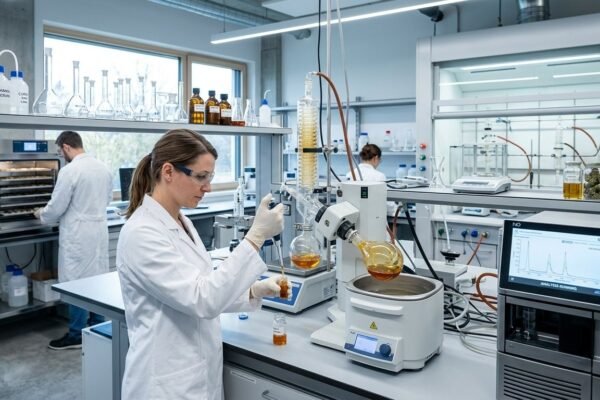
what is the strongest synthetic cannabinoid?
In the landscape of new psychoactive substances (NPS) and chemical research, the structural evolution of synthetic cannabinoid receptor agonists (SCRAs) has moved at a rapid pace. For researchers and toxicologists tracking these developments, one question frequently arises: what is the strongest synthetic cannabinoid currently identified?
While older generations of cannabinoids like JWH-018 or AM-2201 were significantly stronger than natural THC, modern generations have introduced ultra-potent third- and fourth-generation structures. Today, compounds belonging to the indole-3-carboxamide and indazole-3-carboxamide families—specifically MDMB-4en-PINACA, 5F-MDMB-PICA, and ADB-BUTINACA are classified as some of the strongest synthetic cannabinoids in existence.
Comparing Potency and Receptor Affinity
To understand why these specific research chemicals are incredibly powerful, we have to look at how they interact with the body’s endocannabinoid system, particularly the CB1 receptor in the brain.
Unlike natural THC, which is only a partial agonist, these modern synthetic variations act as full agonists with a massive binding affinity.
| Compound Name | Generation Tier | Receptor Type | Binding Profile / Activity |
|---|---|---|---|
| THC (Natural Cannabis) | Baseline | Partial Agonist | Weak binding affinity; limited cellular response. |
| JWH-018 (First Generation) | Early Generation | Full Agonist | Approx. 4 to 5 times stronger than natural THC. |
| ADB-BUTINACA | Modern Tier | Full Agonist | High-potency indazole; active in sub-milligram ranges. |
| MDMB-4en-PINACA | Advanced Tier | Ultra-Full Agonist | Extreme CB1 potency; structurally optimized for maximum receptor activation. |
The Mechanics of Extreme Potency
What makes a modern compound like MDMB-4en-PINACA or 5F-MDMB-PINACA the strongest tier of synthetic cannabinoids? The answer lies in their chemical optimization:
- The Alkyl Chain Modification: Modern variations feature specialized fluorinated or terminal alkene chain extensions (like the “4en” group) that allow the molecule to lock flawlessly into the CB1 receptor pocket.
- Zero Ceiling Effect: Because they are full agonists, they completely saturate the receptor site, causing a massive, continuous cellular signal that natural cannabis simply cannot replicate.
- Microgram Activation: The strongest structural profiles are so potent that their active threshold is measured in micrograms (\(\mu\text{g}\)) rather than milligrams (\(\text{mg}\)), requiring specialized laboratory equipment to measure accurately.
Analytical Tracking and Detection
what is the strongest synthetic cannabinoid? Because the structural architecture of the strongest synthetic cannabinoids changes constantly to keep pace with global regulations, they can be difficult to track using standard on-site screening methods.
However, modern analytical laboratories utilize advanced Liquid Chromatography-Tandem Mass Spectrometry (LC-MS/MS) profiling. This technology shatters the chemical compounds down to their base molecular weight markers, allowing forensic analysts to identify even trace amounts of ultra-potent metabolites in biological matrices.
Disclaimer: This article is intended solely for educational and laboratory research reference purposes. It does not provide medical or legal counsel.